Creature Animation - Mocap VS Handkey - Master Research
Intro:
Hi! I’m Yaro Copijn, a 3D Character Animator from the Netherlands with a fascination for anything that moves, from fast-paced character combat to massive creatures walking across the screen. I’ve worked on a variety of mainly video-games, both big and small.
In this blog, I’ll walk you through my research project, did as part of my Master’s in Game Technologies at Breda University of Applied Sciences (BUAS). The focus of my study was to explore whether human-performed motion capture could help streamline the animation workflow for creating creature locomotion for video games. I investigated whether mocap could accelerate the animation process compared to traditional handkey / Keyframe workflows, using the same character brief across both workflows. I also looked at how believable the resulting mocap animations were when put up against their handkeyed counterparts.
The Goal: speed up the creation of creature locomotion animations
As an animator, like many others, I love bringing creatures to life. In games, that often starts with creating locomotion animations so the creature can move and interact with the world. Having created many cycles for different types of creatures, I know firsthand how time-intensive this process can be. I’ve also worked with motion capture primarily for human characters and have seen the production efficiency it can offer. A few years before starting this research, I explored the idea of applying mocap to creatures for the first time by experimenting with a raptor in a personal project. This was really interesting and showed me the practical potential beyond just the fun idea. It sparked a key question for me: can motion capture actually reduce the production time for creature animation? That curiosity eventually became the foundation of this research project.
First steps:
I started by looking into what was already out there, what techniques were being used, and whether mocap for creatures was already being explored. That’s when I discovered that the VFX and film industry has been using motion capture for some creatures like the raptors in Jurassic World (2015). I also came across companies like Creature Bionics, which specialize in this type of work by training actors and developing body extensions that help performers physically embody creature forms more accurately during capture.
This was really interesting, and it made me wonder whether these techniques and insights could also be applied to creating animations for video games. After running several tests with different creature types, like bipeds and quadrupeds, experimenting with arm extension and other props, I eventually settled on a quadruped setup using arm extensions during the capture.
To help ensure a consistent creature for both workflows, I used the “Finding Your Creature” guide by Ace Ruele as a foundation for building the character briefing.
Methodology

Flow chart of the basic locomotion
Based on these findings, it was decided that a basic locomotion cycle would be the most effective way to evaluate the two techniques against each other. Both workflows were developed using the same character brief, and the time required to complete the animations was recorded and later compared during the analysis.
To assess whether the motion capture workflow could produce believable results, a survey was conducted and distributed to both animators and non-animators. A total of 53 participants completed the survey.
During the creation of the animation:
In the character briefing a Maned wolf was chosen as the main reference for how the creature would walk, clear direction were also establish for breathing and other traits that would lead to their movements. As the study of the reference was needed for both workflows this was not recorded in the creation times as this would evened out.

Syncsketch was used to analyse reference clips
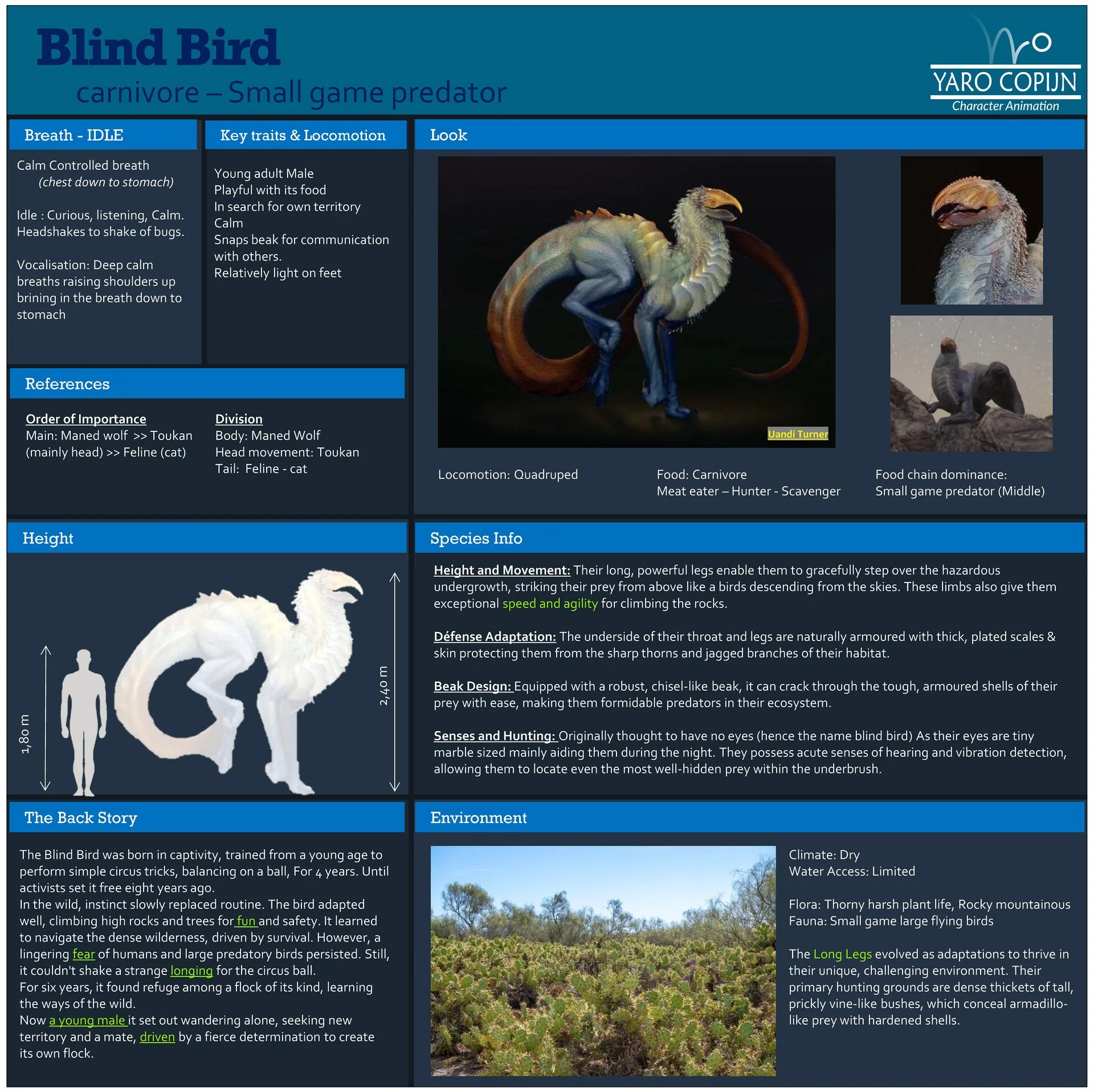
Character briefing
Mocap shoot:
Mocap recording using Vicon optical system
To align with industry standards and practices, MotionBuilder was used for retargeting and the initial mocap cleanup, while Maya was used for the hand-keyed workflow. The mocap animations were later brought into Maya as well to ensure consistency in rendering and final tweaks across both workflows.
For the motion capture session, the movements of a maned wolf were studied and used as reference. To help the performer embody a quadruped more naturally, arm extensions were used during the shoot. These didn’t have any markers on them, they were purely there to support more convincing movement. The time spent on preparing the mocap shot list and the recording all of the creature’s movements was included in the total animation time for the mocap workflow.
Raw Data Retargeting
Raw data retarget to the
During the mocap cleanup process, I followed a technique similar to the one outlined in Jurassic Mocap, and More (2018). At the beginning of each clip, the performer struck a base pose, which I cleaned up once and then reused across all the other takes by applying it through MotionBuilder’s Pose Controls. This approach saved a lot of time and helped streamline the overall cleanup workflow.
Single cleaned up Base Pose applied
Clean up end result mocap walk cycle
After the initial clean-up in MotionBuilder, mainly focused on reducing foot sliding and correcting offsets of the chest and back the mocap animation was transferred to the creature rig in Maya for final polish. This included adjusting limb placements, refining contact points, and adding subtle overlapping motion where needed. and the hand keying of the tail using the tool Overlapper. While the base performance came through nicely thanks to the arm extensions and planning, quite some extra clean-up was still required to make the quadruped movement feel grounded and game-ready.
Although the animation might not look as perfectly smooth as one might expect, this was an intentional choice. Real creatures don’t move with mechanical precision, and mocap is great at capturing those subtle imperfections. These micro-errors were deliberately left in, as cleaning them up too much would risk losing some of the natural feel.
A similar process was followed for the rest of the animation types, including Idle, Start Walk, and Stop Walk.
Handkey/Keyframe:
The hand-keyed version was created in Maya using a traditional approach based on key poses and breakdowns. Starting from the same character brief as the mocap workflow, the process involved blocking out the major poses first to establish timing and intent, followed by breakdowns and in-betweens to shape the motion. the tail was also made using overlapper after the body motion was locked in.
Walk Cycle Keyposes + Breakdowns Handkey
Walk Cycle made using Handkey
the Walk cycle animation was later used as a foundation for the start, stop, and idle animations to maintain consistency across the full locomotion set. Reusing a cycle like this is a common practice when building locomotion, as it helps ensure smooth transitions and a coherent performance throughout. It’s also a practical way to save time when creating a hand-keyed locomotion set.
For both workflows the root was animated at a constant speed, a common practice in game animation workflows to ensure clean and consistent motion during locomotion cycles and prevent foot sliding when used in game.
The Results: Creation Times – Does Mocap Really Save Time?
One of the big questions I wanted to answer was whether motion capture could actually save time when creating creature locomotion animations compared to the more traditional Handkey/keyframe approach. Surprisingly, the answer turned out to be: not really.
In practice, the mocap workflow ended up taking about 10 hours longer than Handkeying to reach an acceptable result. Even when comparing my own creation times (as someone at a junior level) to expert estimations, the keyframed animations generally lined up well with what the pros expected. But the mocap animations, particularly the Idle and Walk Cycle, took quite a bit longer than the expert estimates suggested they would.
When comparing the expert estimation data for both workflows, the total time to create the animations ended up being roughly the same if anything, mocap took a bit longer than hand-keying. So the idea that mocap automatically speeds up animation doesn’t really hold up in this case. The extra time needed to clean up and tweak the mocap data can actually make it a little less efficient than expected.
So, does mocap save time for creating quadruped creature locomotion game animations? Based on the data: not really. The results didn’t show a meaningful time-saving advantage, and statistically, the difference wasn’t significant either.
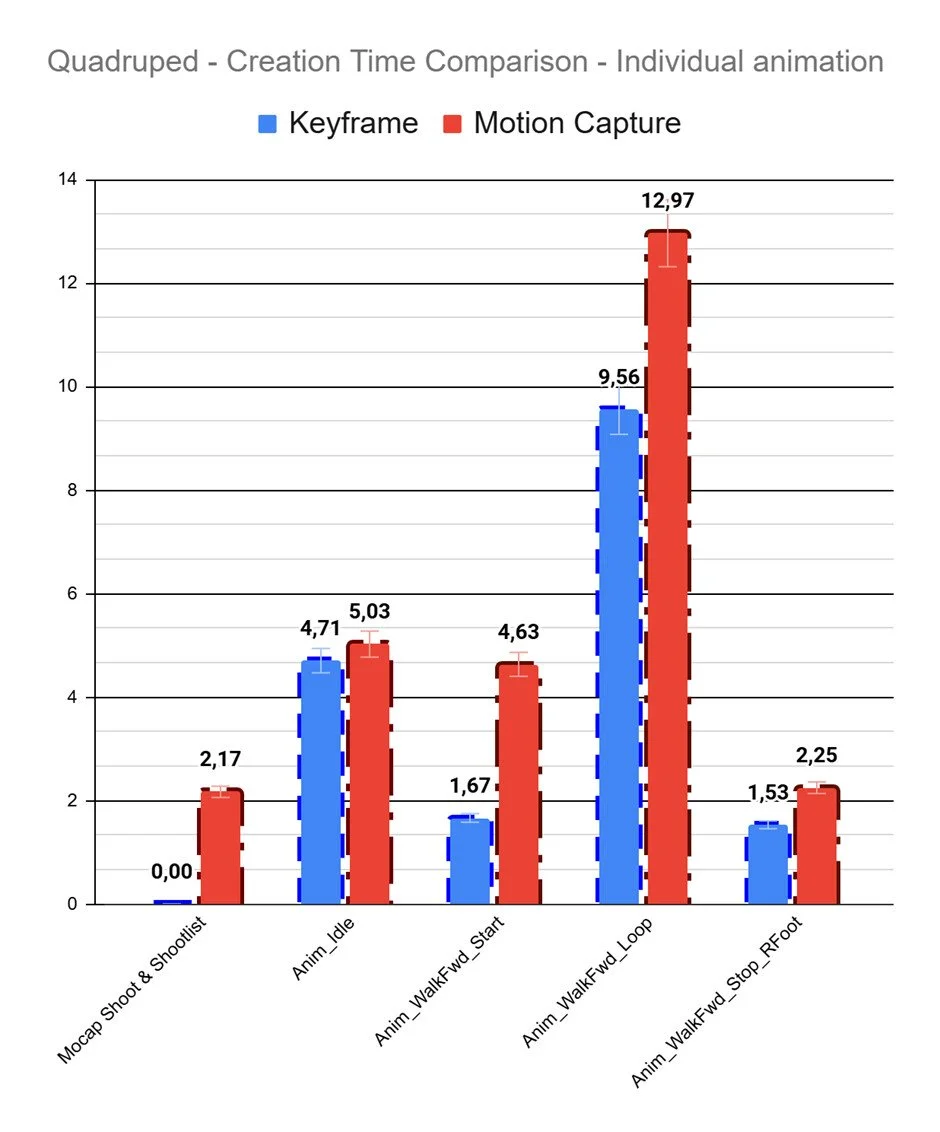
Creation times comparison Handkey/Keyframe VS Mocap
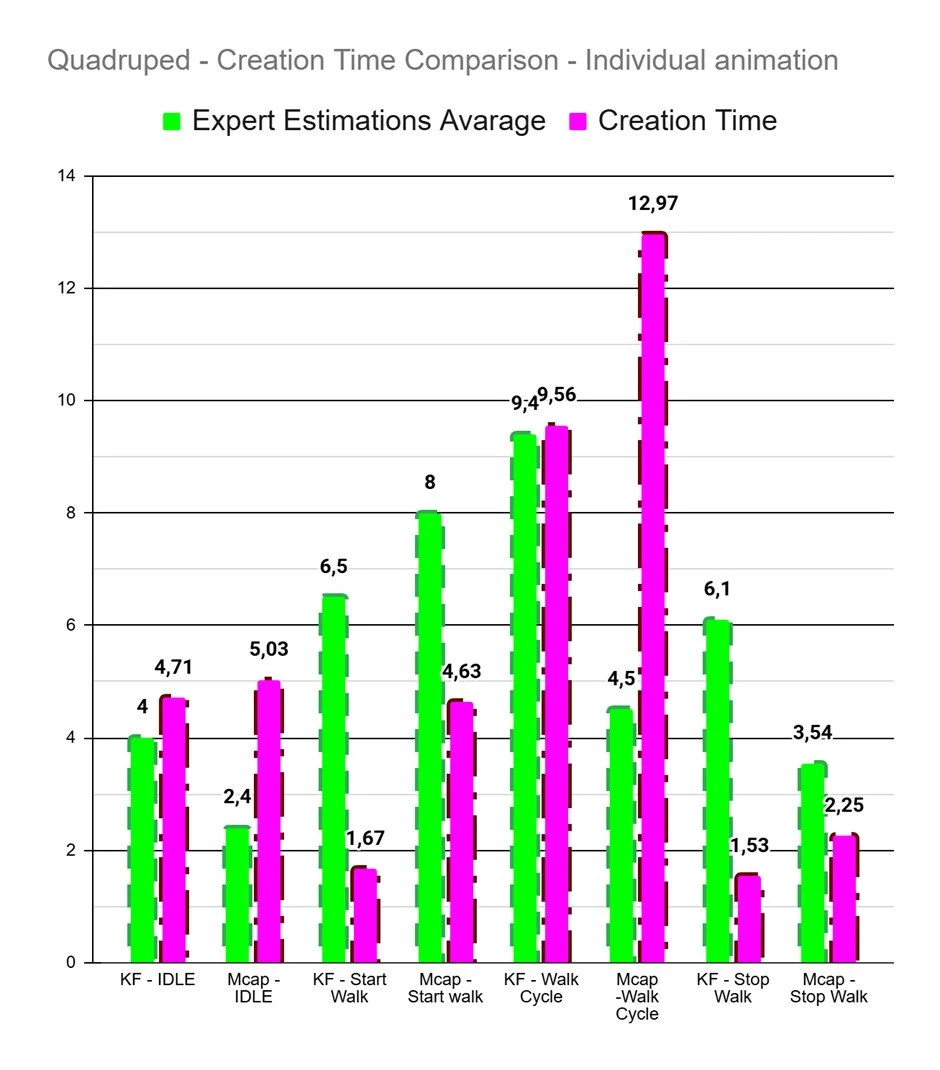
Experts average creation time estimations
The Results: Believability Does Mocap produce believable animation ?
To see how believable the animations actually felt, a survey was run with 53 participants—27 with animation experience and 26 without. Everyone was shown A/B comparisons between the mocap and handkeyed animations and asked to pick which one they found more believable.
This example shows the idle animation clip used during the survey phase to gather participant preferences on believability and animation quality. Participants were not informed which animation was created using which workflow, ensuring unbiased data.
The results showed that in some, mocap in some cases was able to hold its own. While handkeyed animations were preferred for the walk cycle and start walk where the difference was statistically significant. Mocap still proved competitive. For animations like idle and stop, participants were split almost evenly, suggesting that mocap can deliver some results that feel just as believable as traditional keyframing.
To simulate how these animations work in a game context (since the participants before saw only the animation in isolation per animation type), a final video showed all of them strung together to mimic in-game movement. Participants leaned a little more toward the keyframed version again, but this time the difference wasn’t statistically significant. suggesting that mocap can lead to believable animation.
One interesting result came from the walk cycle: animators strongly preferred the keyframed version, while non-animators leaned (slightly) toward the mocap one.
Overall Conclusion
This study explored whether motion capture (mocap) can deliver believable quadrupedal animations on par with hand-keying, and whether it offers any time-saving benefits. The results show that mocap isn’t actually faster, it takes about the same amount of time, or even a bit longer. While mocap can occasionally match the quality of hand-keyed animation, the lack of time efficiency means that hand-keying still feels like the more practical and reliable choice for now when balancing quality and speed in game animation.
Insights & Takeaways
While approaching this research with an open mind, I was genuinely surprised by the results. I had expected motion capture to offer some kind of time-saving benefit, but that didn’t turn out to be the case. Looking back at the creation process, and as many sources suggest, it became clear that hand-keyed animation offers more precise control over each movement. That level of control proved especially useful and, in my experience, contributed to greater efficiency overall.
With hand-keying, you fully understand the motion you're creating from the inside out. In contrast, while mocap does provide a solid starting point and allows for quick progress after initial cleanup, the later stages of refinement, particularly removing the human nuances to suit a creature, ended up being more time-consuming than expected.
Overall, this research was a great experience. It taught me a lot, not just about animation, but also about what goes into conducting industry relevant proper research. Along the way, it helped me improve my own skills and workflow. More than anything, it satisfied a curiosity I had about whether using mocap for creature animation was truly possible and more efficient. While the answer wasn’t what I expected, the process of finding it was incredibly valuable.
Special Thanks ❤️:
I would like to extend my sincere gratitude to my supervisors, Luca Quartesan and Zoltan Batho G, for their invaluable support and guidance throughout this research.
A heartfelt thank you to Denise Emerson and Marlon Nowé for their feedback on the animation during the project.
Also, special thanks to the Mocap team who assisted with the motion capture shoot, your help was essential to making this project possible.
Alina Stašāne
Esmee Horler
Moss Dzienis
Remco Nijs
Nikolay Chalakov
To everybody who provided feedback and filled in the survey for this experiment thank you ❤️.
Creature rig : Blind Bird Maya Rig: MRINAL Soni, Blind Bird Mesh + Textures : Uandi Turner.